
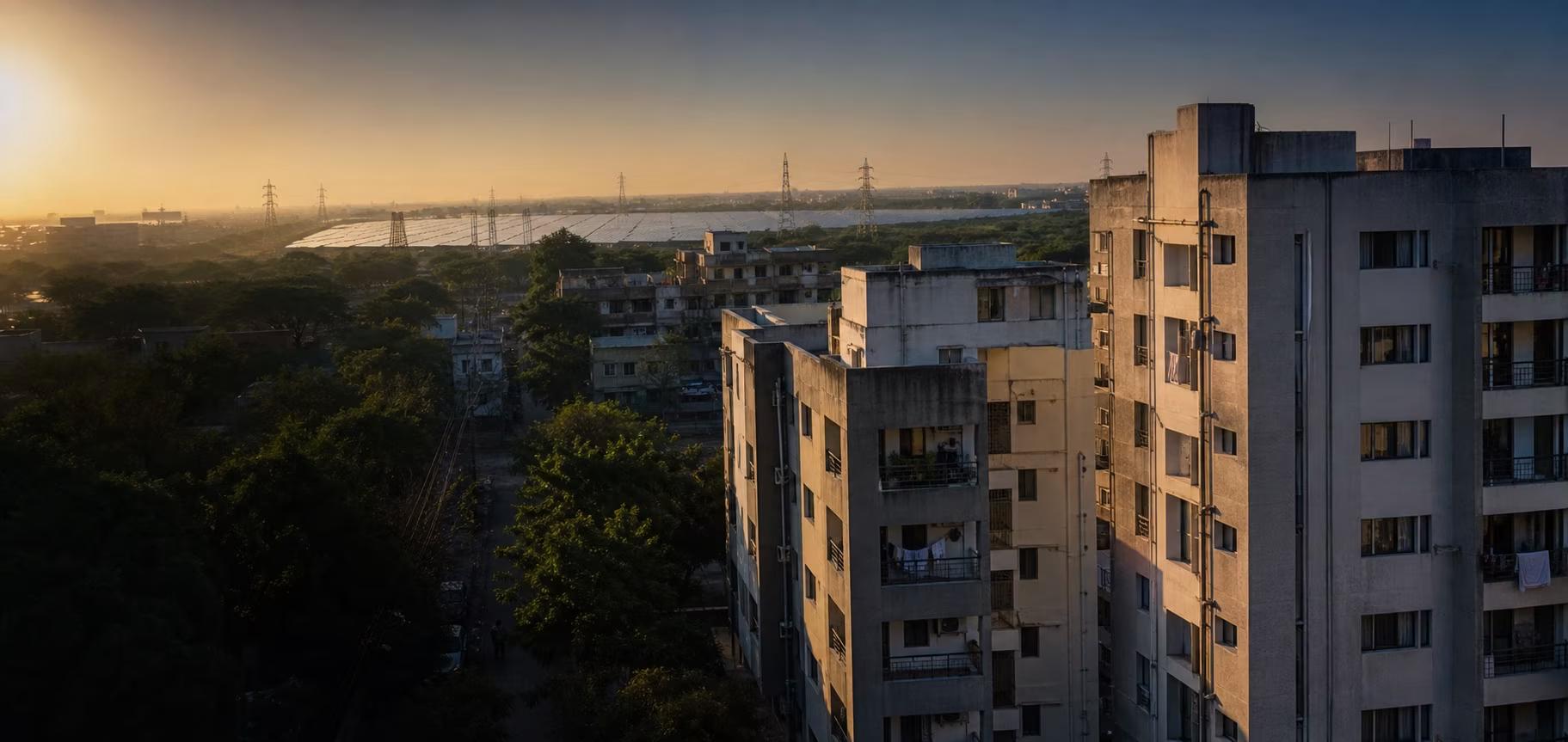
Why Apartments Can Be Challenging for Rooftop Solar
Traditional rooftop solar is easier for an independent property with dedicated roof access. Apartments can be more complicated because the roof may be common property, installation decisions may require society approval, and the available roof area may not be sufficient for every flat.
Shared Roof Rights
The roof is often common property, so an individual flat owner may not have exclusive rights to install equipment there.
Limited Roof Area
The available roof may need to serve many apartments, common areas and other building equipment.
Approval Complexity
Common-area solar projects can require society, RWA or other building-level approvals and agreements.
Tenant Limitations
Tenants generally cannot make permanent changes to a building or rooftop without the required permissions.
Maintenance Responsibilities
A building-level rooftop system needs defined responsibilities for cleaning, monitoring, repairs and equipment access.
Property-Bound Equipment
A rooftop installation is associated with the building, which can make ownership and portability more complicated when residents move.
Community Solar: One Option for Apartment Residents
Community and managed-solar models can separate the location of solar generation from the consumer's home. Where the applicable regulatory framework permits it, generation from a renewable-energy project can be allocated or credited to participating electricity connections through mechanisms such as Virtual Net Metering (VNM).
Individual Participation
Where permitted, eligible residents can participate based on the requirements of their electricity connection and the applicable programme.
Building-Level Options
Apartment societies can also explore common-area rooftop solar or other group arrangements where the applicable rules support them.
No Private Rooftop Required
A remote managed-solar arrangement does not require panels to be installed on the roof of your individual flat.
How Much Solar Can an Apartment Get?
Solar allocation is not determined by the number of bedrooms alone. Depending on the programme, it can be affected by your sanctioned load, consumer category, applicable DISCOM rules, project capacity and the settlement mechanism.
| Flat Type | Example Sanction Load | Example Solar Size | Indicative Monthly Generation | Potential Bill Impact |
|---|---|---|---|---|
| 1 BHK | 3 kW | Up to 3 kW* | Approx. 300–360 kWh | Depends on consumption |
| 2 BHK | 5 kW | Up to 5 kW* | Approx. 500–600 kWh | Depends on consumption |
| 3 BHK | 7 kW | Up to 7 kW* | Approx. 700–840 kWh | Depends on consumption |
| 4 BHK / Penthouse | 10+ kW | Programme dependent | Project dependent | Depends on consumption |
* Important: These are illustrative examples, not universal regulatory limits. Actual solar allocation depends on the applicable state or DISCOM rules, consumer category, sanctioned load, programme design and project capacity. Generation also varies with location, system design, weather and operating conditions.
Common-Area Solar vs. Individual Managed Solar
| Aspect | Common-Area Rooftop Solar | Individual Managed Solar |
|---|---|---|
| Approval | Usually requires building/society approval and compliance with applicable rules | Depends on the programme and DISCOM requirements |
| Roof Space | Uses the building’s available rooftop area | Generation can be located at an eligible remote project |
| Allocation | Society or project-specific allocation method | Based on the applicable programme and participating connection |
| Maintenance | Society or appointed service provider manages the system | Solar project operator manages the generation asset |
| Tenant Access | Depends on ownership, society rules and project structure | May be available where the applicable programme allows eligible tenants or consumers to participate |
| Portability | Equipment remains associated with the building | Transferability depends on programme and provider terms |
| Generation Site | Building rooftop | Potentially a remote solar project |
Where Can Apartment Residents Access Managed Solar?
Rules differ significantly between states and DISCOMs. A programme that is available to apartment residents in one jurisdiction should not automatically be assumed to be available in another.
Delhi
BRPL, BYPL, TPDDL and other applicable distribution areas
Odisha
State distribution licensees and applicable DISCOM areas
Karnataka
BESCOM, MESCOM, HESCOM, GESCOM, CESC and applicable areas
Maharashtra
MSEDCL, BEST and other distribution licensees
Regulatory frameworks and DISCOM procedures can change. Always verify current eligibility, capacity limits, metering arrangements, charges and application procedures before subscribing or investing.
What About Tenants?
Renting an apartment does not automatically rule out participation in a managed-solar programme. The important questions are whether the electricity connection is eligible, whether the programme accepts the consumer category, and whether the applicable rules allow the proposed arrangement.
No Private Rooftop Required
A remote managed-solar arrangement does not require you to install panels on the apartment roof.
Check Account Requirements
Eligibility can depend on the electricity account, consumer category and documentation.
Review Transfer Terms
If you move, check whether the programme permits transferring or ending the subscription.
Common Questions Before Subscribing
What will appear on my electricity bill?
The exact treatment depends on the applicable metering or settlement mechanism. Ask the provider and DISCOM how generation, credits, charges and any remaining consumption will appear on the bill.
Can I choose any solar farm?
Not necessarily. The project must meet the applicable regulatory, interconnection and programme requirements, and your electricity connection must be eligible for the arrangement.
Can I subscribe for more solar than I consume?
Do not assume that you can. Allocation and settlement limits depend on the applicable regulations, sanctioned load, consumer category and programme design.
Does solar eliminate my electricity bill?
Not necessarily. Electricity tariffs, fixed charges, taxes, fees, programme charges, consumption and the applicable credit mechanism can all affect the final bill.
Getting Started for Your Apartment
1. Check Eligibility
Provide your DISCOM, consumer category, electricity connection details and location so the applicable eligibility requirements can be assessed.
2. Calculate Your Solar Potential
Estimate solar generation and potential bill impact based on your consumption rather than relying only on apartment size.
3. Explore the Lumifly Network
Explore available Lumifly solar projects and network locations where capacity and programme eligibility permit participation.
Important: Rules and Savings Can Change
Community solar, Virtual Net Metering, Group Net Metering, rooftop solar and related programmes are governed by state regulators, DISCOMs and programme rules. Eligibility, capacity limits, credit treatment, charges and application procedures can change over time. The information on this page is educational and should not be treated as a guarantee of eligibility or savings.