
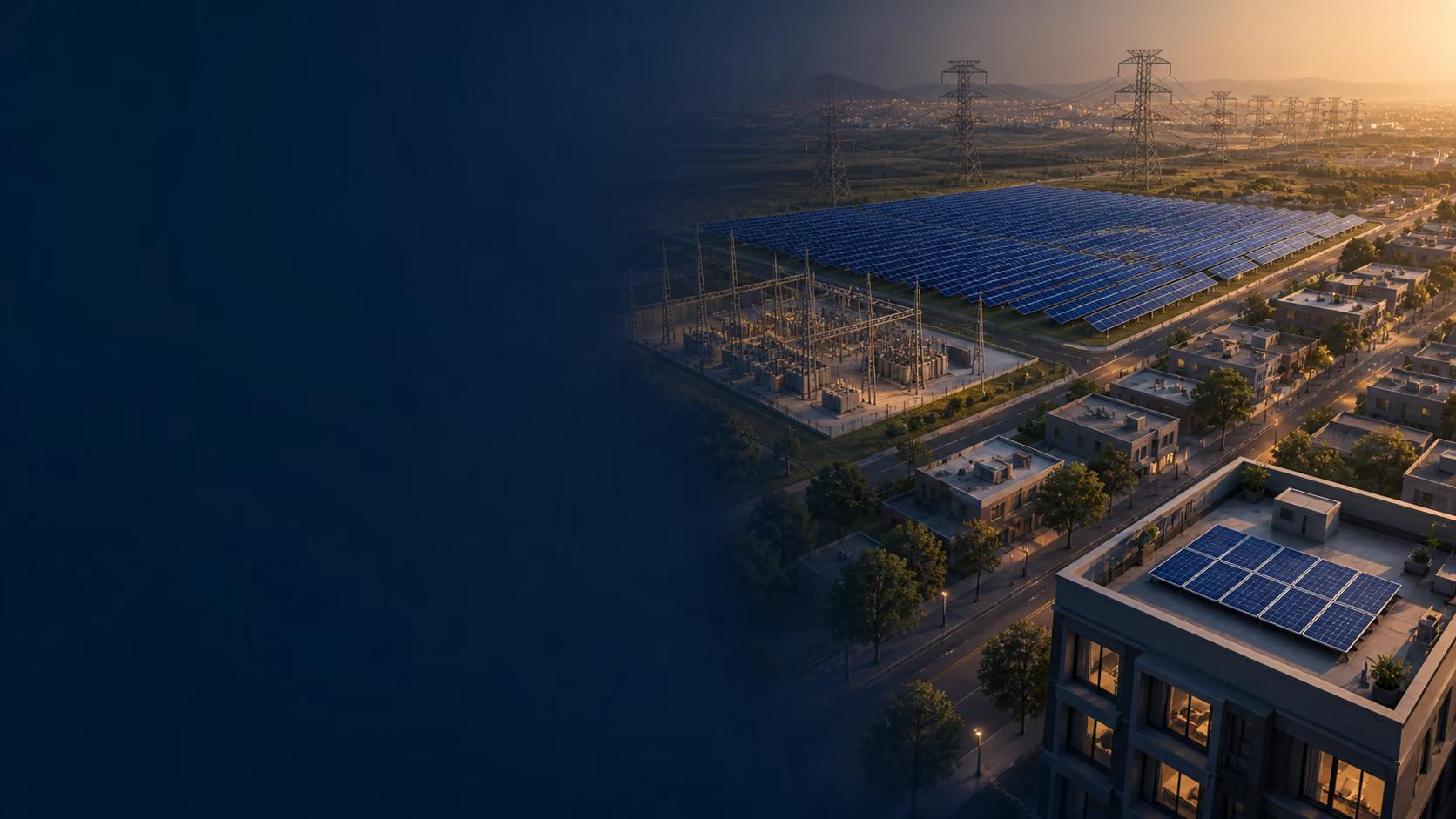
Side-by-Side Comparison
| Factor | Rooftop Solar | Community Solar |
|---|---|---|
| Upfront Cost | High (₹1.5–2.5L for 3 kW) | Zero (subscription model) |
| Rooftop Required | Yes — suitable roof needed | No — works for any meter |
| Home Ownership | Typically required | Not required |
| Installation at Home | Yes — panels, wiring, inverter | No — remote solar farm |
| Maintenance | Your responsibility (cleaning, repairs) | Developer handles all O&M |
| Portability | Difficult — stays with property | Portable within DISCOM area |
| Generation Efficiency | Constrained by roof (shading, orientation) | Optimal siting + tracking + bifacial |
| Capacity Factor | 14–18% | 18–22% (tracking: 22–26%) |
| Regulatory Model | Net Metering | Virtual Net Metering (VNM) |
| Apartment Access | Very limited | Full access via individual meter |
| Renter Access | Effectively impossible | Yes (meter-based) |
| Control | Full — you own the system | Limited — subscription terms |
| Long-Term Value | Higher absolute return (30–40x investment) | Zero capital, 10–15% annual yield |
When Rooftop Solar Makes Sense
✓You own your home
You have full rights to install and maintain panels on your roof.
✓Suitable roof available
Unshaded, structurally sound, south-facing (or east/west with reduced output).
✓You want maximum long-term savings
You have capital and want the highest absolute return over 25 years.
✓You plan to stay long-term
Payback is 4–7 years; staying 10+ years maximizes value.
✓You want full control
You want to own the system, decide on upgrades, and manage maintenance yourself.
When Community Solar Makes Sense
⚡You live in an apartment
No individual rooftop access — community solar works with your electricity meter.
⚡You rent your home
No landlord permission needed — subscription follows your meter, not the property.
⚡Your roof is unsuitable
Shaded, small, structurally limited, or wrong orientation — community solar bypasses all roof constraints.
⚡You want zero upfront cost
No capital required — pay a monthly subscription instead of ₹1.5–2.5L upfront.
⚡You value simplicity
No installation, maintenance, permits, or equipment at home — just solar credits on your bill.
⚡You may move
Subscription is portable within the same DISCOM area — moves with your electricity connection.
Cost Comparison (Indicative)
Rooftop Solar (3 kW)
- • Upfront cost: ₹1.5–2.5L (before subsidy)
- • After PM Surya Ghar subsidy: ₹72,000–1.72L
- • Annual savings: ₹25,000–35,000
- • Payback: 4–7 years
- • 25-year savings: ₹6–10L+
- • Ongoing costs: Cleaning (₹2,000–5,000/yr), inverter replacement (₹30,000–60,000 at year 10–12)
Community Solar (3 kW share)
- • Upfront cost: ₹0 (subscription model)
- • Monthly subscription: ₹1,000–2,000
- • Monthly VNM credits: ₹2,000–3,000
- • Net monthly savings: ₹800–1,500
- • Annual savings: ₹10,000–18,000
- • Payback: Immediate (Month 1)
- • Ongoing costs: Included in subscription
Disclaimer: Figures are indicative. Actual costs, savings, and subscription fees vary by location, DISCOM, VNM credit rate, and specific agreement terms. Contact us for a personalized estimate.
Which Should You Choose?
The Short Answer
Choose rooftop solar if you own a suitable home, have capital, and want maximum long-term savings with full control. Choose community solar if you rent, live in an apartment, have an unsuitable roof, or prefer zero upfront cost and maximum simplicity.
Many customers start with community solar and later add rooftop solar if they purchase a home. Both are valid paths to clean energy.