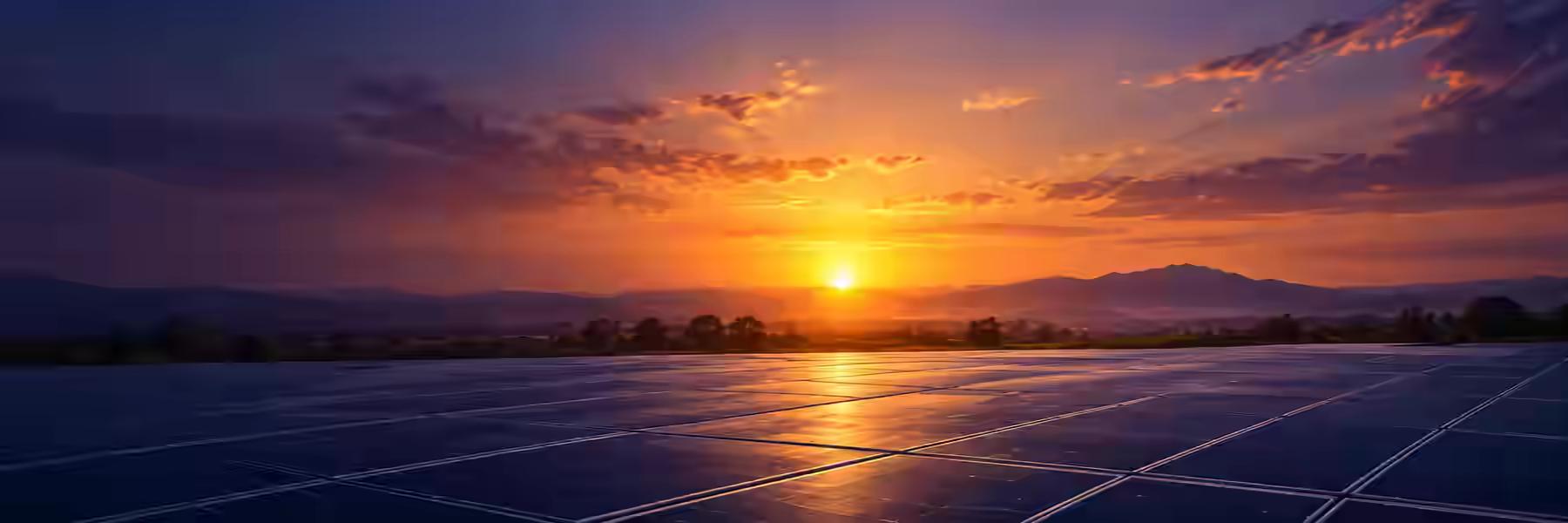
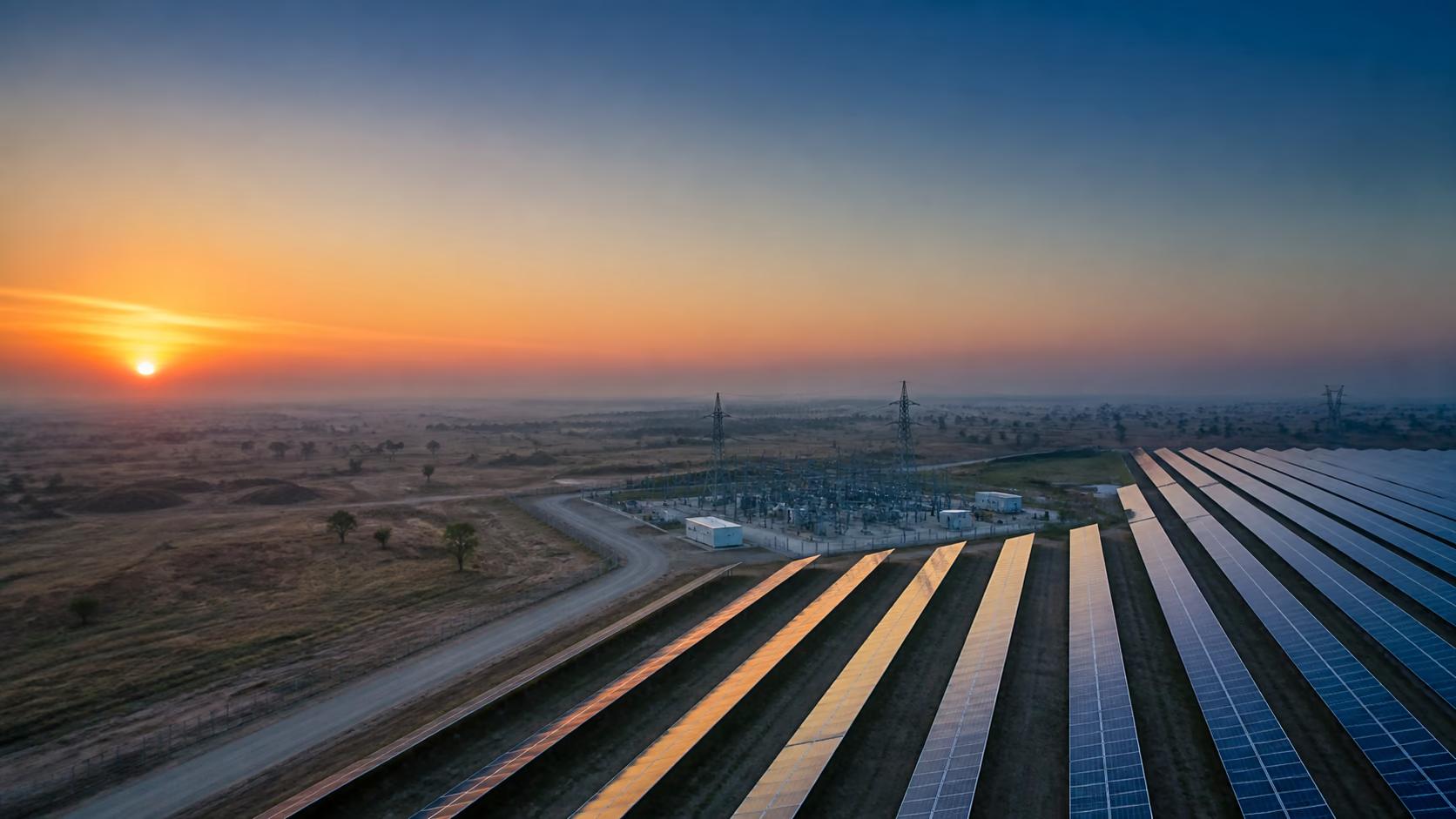
Definition
A solar farm (also called solar park, photovoltaic power station, or utility-scale solar) is a large-scale, ground-mounted solar photovoltaic installation designed to generate electricity for the grid — not for on-site consumption.
Key characteristics:
- • Scale: 1 MW to 1,000+ MW (vs. 3–10 kW rooftop)
- • Mounting: Ground-mounted on steel structures (vs. roof-mounted)
- • Connection: Direct to transmission/distribution substation (vs. behind-the-meter)
- • Off-take: Power Purchase Agreement (PPA) or merchant sale to grid (vs. net metering)
- • Economics: Lowest levelized cost of electricity (LCOE) of any generation technology
Solar Farm vs. Rooftop Solar
| Factor | Rooftop Solar | Solar Farm |
|---|---|---|
| Typical Size | 3–10 kW (residential) | 1 MW – 1,000+ MW |
| Location | On your roof (constrained) | Optimal land (unconstrained) |
| Orientation | Fixed by roof | Optimized (south, latitude tilt, or tracking) |
| Shading | Trees, tanks, parapets | None — designed out |
| Equipment | Residential-grade | Utility-grade (higher spec, longer life) |
| Inverter | String / microinverters | Central / string inverters (MW-scale) |
| O&M | Homeowner / small contractor | Professional O&M team, SCADA monitoring |
| Cost per Watt | ₹50–70/W (installed) | ₹35–50/W (installed) |
| Capacity Factor | 14–18% | 18–22% (tracking: 22–26%) |
| Land Use | Zero additional land | 4–5 acres per MW |
Anatomy of a Solar Farm
PV Modules
Bifacial monocrystalline (540–600Wp). Mounted on fixed-tilt or single-axis trackers. 20–25 year performance warranty.
Mounting Structures
Galvanized steel piles (driven) or concrete foundations. Fixed-tilt (seasonal adjustment) or single-axis trackers (east-west rotation).
Inverters
Central inverters (2–4 MW each) or string inverters (100–350 kW). High efficiency (98.5%+), grid-support functions (LVRT, HVRT, reactive power).
Transformers & Substation
Step-up transformers (0.8/33 kV or 11/33 kV). Dedicated pooling substation with breakers, protection, metering. Grid interconnection at 11/33/66/132/220 kV.
DC/AC Cabling
XLPE insulated cables. DC from modules to inverters. AC from inverters to transformers. Sized for voltage drop <1–2%.
SCADA & Monitoring
Plant-level SCADA: real-time generation, string-level monitoring, weather stations, soiling sensors, performance ratio tracking, automated alerts.
Weather Station
Pyranometers (GHI, POA), temperature, wind speed/direction, humidity. Reference for performance ratio calculation.
Security & Fencing
Perimeter fencing, CCTV, access control. Fire safety: detection, suppression, evacuation routes.
O&M Building
Control room, spare parts storage, workshop, staff facilities. 24/7 monitoring for large plants.
Tracking Systems: Fixed vs. Single-Axis
Fixed-Tilt
- • Simpler, lower capex, lower O&M
- • Tilt = latitude angle (or seasonal 2-position)
- • Capacity factor: 18–20%
- • No moving parts, higher reliability
- • Better for high wind zones
Single-Axis Tracker
- • 15–25% more energy than fixed-tilt
- • Rotates east-west following sun
- • Capacity factor: 22–26%
- • ~10% higher capex, motors/gearboxes need maintenance
- • Backtracking algorithm avoids row-to-row shading
Bifacial Modules: The New Standard
Most modern solar farms use bifacial modules — cells on both sides of the glass. The rear side captures reflected (albedo) light from the ground.
Bifacial Gain Factors
- • Ground albedo: White sand/concrete (30–40%) > grass (15–20%) > dark soil (10–15%)
- • Module height: Higher = more rear irradiance (but more wind load)
- • Row spacing: Wider spacing = more ground-reflected light reaches rear
- • Typical bifacial gain: 5–15% additional energy vs monofacial
Technology: N-Type TOPCon / HJT
N-type silicon (phosphorus-doped) has lower degradation (LID/LeTID immune), better temperature coefficient, higher bifaciality factor (80–90% vs 70% for PERC). HJT (heterojunction) adds intrinsic thin-film layers for 24%+ efficiency.
Land Use & Agrivoltaics
Solar farms need ~4–5 acres per MW (fixed-tilt) or ~5–6 acres/MW (trackers). In India, many are on barren/waste land. Emerging dual-use models:
Agrivoltaics
Crops grown under raised panels (3–4m height). Panels provide shade, reduce evaporation, protect from hail. Suitable for shade-tolerant crops (leafy greens, herbs, certain vegetables).
Grazing
Sheep/goats graze between rows. Natural vegetation control (reduces mowing cost). Animals benefit from shade. Common in US/Europe, emerging in India.
Pollinator Habitat
Native wildflowers under panels. Supports bees, butterflies. Improves biodiversity, soil health, community acceptance. Low maintenance.
Water Conservation
Floating solar on reservoirs reduces evaporation (up to 70% reduction). Panels run cooler = higher efficiency. Dual benefit: energy + water savings.
India's Largest Solar Parks
| Park | State | Capacity | Model |
|---|---|---|---|
| Bhadla Solar Park | Rajasthan | 2,245 MW | Ultra Mega Solar Park (central govt) |
| Pavagada Solar Park | Karnataka | 2,050 MW | Land lease model (farmers lease land) |
| Kurnool Ultra Mega | Andhra Pradesh | 1,000 MW | Central govt scheme |
| NP Kunta | Andhra Pradesh | 1,500 MW+ | Phased development |
| Rewa Solar Park | Madhya Pradesh | 750 MW | First to break ₹3/unit tariff barrier |
Why Solar Farms Enable Community Solar
Community solar subscribers benefit from solar farm economics:
- • Lower ₹/kWh: Utility-scale LCOE (₹2.5–3.5/kWh) vs rooftop (₹4–6/kWh)
- • Higher generation: Optimal siting + tracking + bifacial = 20–30% more kWh/kW
- • Professional O&M: 99%+ uptime, predictive maintenance, real-time monitoring
- • No roof risk: No leaks, structural issues, or tenant/landlord disputes
- • Scalable: Add capacity by expanding farm — no customer-side disruption