
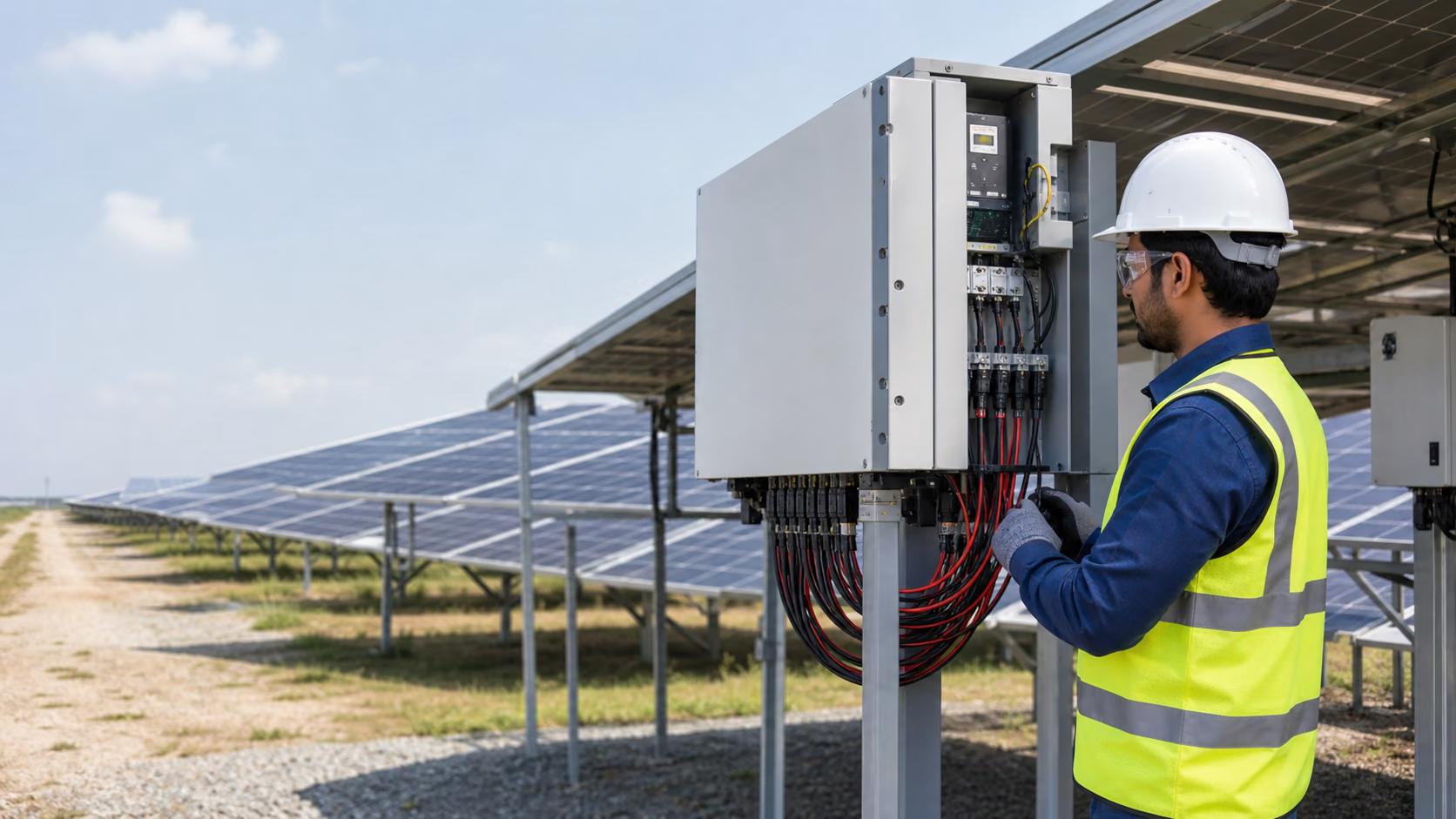
The Photovoltaic Effect: Core Principle
The word "photovoltaic" comes from photo (light) and voltaic (electricity). Discovered by Edmond Becquerel in 1839, the photovoltaic effect is the creation of voltage and electric current in a material upon exposure to light.
In One Sentence
When photons (light particles) strike a semiconductor material like silicon, they transfer energy to electrons, knocking them loose and creating an electric current.
Anatomy of a Solar Cell
Silicon Wafer (The Heart)
Ultra-pure silicon, sliced into thin wafers (~180µm). Doped to create p-type (boron) and n-type (phosphorus) layers forming the p-n junction.
Anti-Reflective Coating
Reduces reflection losses from ~30% to <3%. Usually silicon nitride (blue color) or titanium dioxide.
Metal Contacts (Grid Lines)
Thin silver fingers on front collect electrons. Full aluminum back contact. Designed to maximize light absorption while conducting current.
Encapsulation & Glass
EVA (ethylene vinyl acetate) encapsulant + tempered low-iron glass (front) + polymer backsheet. Protects from moisture, UV, mechanical stress for 25+ years.
Step-by-Step: Sunlight to Electricity
Photon Absorption
Sunlight photons strike the silicon. Photons with energy >1.12 eV (silicon bandgap) are absorbed, exciting electrons from valence band to conduction band.
Electron-Hole Pair Creation
Each absorbed photon creates an electron-hole pair: a free electron (negative) in the conduction band and a "hole" (positive) in the valence band.
Separation by Electric Field
The p-n junction's built-in electric field pushes electrons toward the n-side and holes toward the p-side. This charge separation creates voltage (~0.6–0.7V per cell).
Current Collection
Metal contacts on the cell surface collect the separated electrons. Electrons flow through the external circuit (wires) to recombine with holes on the other side — this flow is electric current.
Module Assembly
Cells are connected in series (voltage adds) and parallel (current adds) to form a module. Typical 60-cell panel: ~30–40V, 8–10A. 72-cell: ~40–50V.
Inverter Conversion
Panel DC output → inverter → AC power (230V single-phase or 415V three-phase in India). Inverter also performs MPPT (Maximum Power Point Tracking) to optimize harvest.
Types of Solar Cells
| Technology | Efficiency | Cost | Best For |
|---|---|---|---|
| Monocrystalline Si (PERC) | 20–23% | Medium-High | Residential/commercial rooftops — space constrained |
| Monocrystalline N-Type TOPCon | 22–24% | High | Premium rooftops, solar farms — lower degradation |
| Monocrystalline HJT | 23–25% | Highest | Highest performance, bifacial farms |
| Polycrystalline Si | 16–18% | Low | Budget installations, large farms where space abundant |
| Thin-Film (CdTe) | 17–19% | Low-Medium | Utility-scale farms, high temperature climates |
| Perovskite (emerging) | 25%+ (lab) | TBD | Future: tandem cells, flexible, lightweight |
The Inverter: Brains of the System
Panels make DC. Homes need AC. The inverter bridges this gap and does much more:
DC to AC Conversion
Switches DC input at high frequency to synthesize clean AC sine wave synchronized to grid (50Hz in India).
MPPT (Maximum Power Point Tracking)
Continuously adjusts electrical operating point to extract maximum power from panels as irradiance/temperature change.
Anti-Islanding Protection
Detects grid outage and shuts down within milliseconds to protect utility workers. Mandatory for grid-tied systems.
Monitoring & Diagnostics
Tracks per-string/per-panel performance, detects faults, reports generation data to apps/portals.
Reactive Power Support
Modern inverters can provide voltage support to grid (Volt-VAR, Volt-Watt) — grid code requirement in many states.
Battery Integration (Hybrid)
Hybrid inverters manage battery charge/discharge, backup power, and time-of-use optimization.
What Affects Real-World Output?
From Panel to Your Appliances
The complete flow in a grid-tied rooftop system:
Solar Panels
DC Generation
→DC Cables
To Inverter
→Inverter
DC → AC + MPPT
→AC Distribution
To Main Panel
→Net Meter
Import/Export
→Your Loads
Appliances
→Grid
Deficit Import / Excess Export